HOME

Cumartesi, Eylül 30, 2006

All You Need is a Girl and a Gun, Part 2


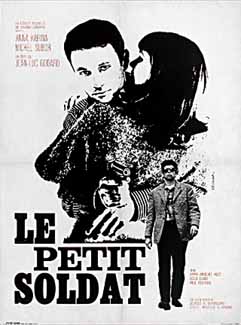
Le Petit Soldat (France, 1960) * * * 1/2
Les Carabiniers (France, 1963) * * *
Contempt (Le Mepris) (France, 1963) * * * *
Operation Beton/Une Histoire D'eau (France, 1954/58)
D: Jean-Luc Godard

The Cinematheque series on the pre-1968 works of Jean-Luc Godard has continued over the past two weeks with three films released in 1963, proving, if nothing else, that Godard was one of the most prolific directors of the French New Wave. (Actually, Le Petit Soldat was completed in 1960 but withheld by French censors until 1963.) The films also make clear the astonishing variety of subject matter Godard was attempting to tackle in his early years, while keeping his very particular stamp on each film. You could see three random clips from Le Petit Soldat, Les Carabiniers, and Contempt, and identify each as a separate film, but at the same time identify none but Godard as the auteur.
Yet the first two are "war" films. Le Petit Soldat ("The Little Soldier") would make an ideal double feature with the better-known (and, indeed, more highly regarded) Battle of Algiers by Gillo Pontecorvo--both are set during the Algerian war as Algeria struggled against its French occupiers for independence. Bruno (Michel Subor) is a young man very much like the one played by Jean-Paul Belmondo in Breathless: an anarchic punk on the run. Ostensibly he belongs to a right-wing, anti-Algerian group, and is ordered to kill a spy sympathetic to the Algerian cause. He falls in love with another Algerian sympathizer, Veronica (Anna Karina, making her first film with Godard), which causes his fellow right-wingers to suspect him of being a double agent. It's a noir film, it's a political film, and it's a quasi-documentary, with Godard adopting the techniques of cinema-verite. But ultimately it is a film about a girl, and a man who finds himself being brutally tortured more or less because of her: he is a martyr for the cause of the girl, and not Algeria or France. The war was still going on when the film was completed, so understandably the French government suppressed the film until Godard's reputation was won and the war lost. I missed the screening of both this and Les Carabiniers due to a schedule conflict, but having seen it a year ago on Turner Classic Movies, what stands out is the transition from the iconic Godardian mix of young gangsters, existential romance, and cinematic experimentation in the early scenes, to the brutally realistic and drawn-out torture of Bruno in the final scenes. The effect is of philosophy and romance being simultaneously stripped away and seared into the flesh.

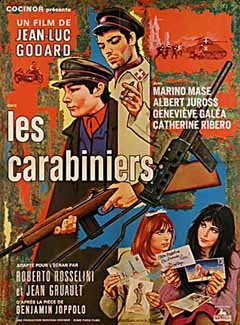
Les Carabiniers ("The Riflemen"), though grouped by the Cinematheque as another "war film," is by contrast a savage satire and fantasy along the lines of Godard's later film, Week-End. In a country that might as well be a more gritty version of the Marx Brothers' Freedonia, two farmers (Albert Jeross and Marino Mase) succumb to the propaganda of their country's army--a war is being arranged, and soldiers are needed--so they enlist under the promise of seeing distant countries, and the opportunity to kill and rape anyone they please. What follows is rather jaunty. We see postcards the boys send back to their cheerful wives. We witness the chaos and the murder. Eventually, the anarchic joy subsides and the weight of the war begins to crush them. Seldom seen, it's actually started making the rounds on TCM over the last couple of years; it's a sharp satire, if a bit obvious and heavy-handed. But when seen in the shadow of the Iraq war--and in particular the reports of American soldiers raping and killing an Iraqi girl, and slaughtering her family, before officers attempted to cover it up--it becomes even more distressing. This is essential Godard, if for no other reason than to see the beginning of a path he will follow for much of the rest of his career, sacrificing subtlety for confrontational politics. I think it works here, because it's kept timelessly simple, almost allegorical.
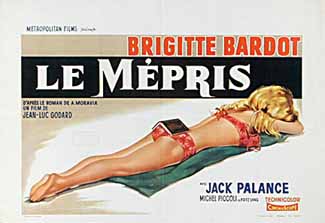
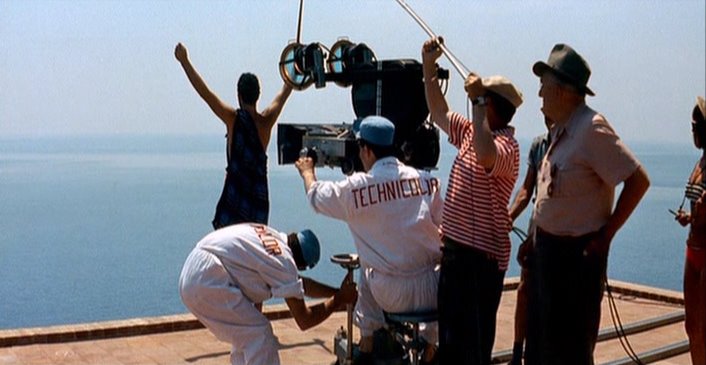
The first Godard film I ever liked was Contempt. Based on the Italian novel Il Disprezzo ("The Ghost at Noon") by Alberto Moravia, it's set in Italy, on the sets of the renowned Cinecitta Studios, where Fellini was making his classic films. This is considered Godard's attempt to make a mainstream, Cinemascope production with a name cast, and as such seems to have split Godard fans between those who consider it one of the greatest films ever made (it usually appears very high on Sight & Sound's critic-polling top 10 list) and those who merely consider it good. Godard, though still married to Anna Karina (his marriage was on the rocks), this time substituted a world-famous star as the film's muse--Brigitte Bardot, whose best-known film to this day is Roger Vadim's mediocre And God Created Woman. Here she is a "typist" married to the older, cynical playwright Paul Javal (Michel Piccoli), who, by contract with Godard, dresses like he's in a film noir and lights a cigarette in every scene. He also carries a gun, fulfilling Godard's notion that "all you need is a girl and a gun," and opening up the threat of violence in what is otherwise a very languid, brightly-lit, Mediterranean film. Paul is hired to rewrite a script for The Odyssey which is being adapted by the legendary German director Fritz Lang (playing himself). The American producer, Jeremy Prokosch (Jack Palance), wants more sex and action, and less of the arty stuff. (Famously, he says, "Every time I hear the word 'culture' I get out my checkbook.") While Paul seems bilingual, his wife Camille only uses the language stumblingly; this doesn't seem to bother Jeremy, intent on seducing her. Jeremy knows very little French, but grins lasciviously while she talks. Fritz Lang is fluent in English and French, but seems the most isolated of all of them, concentrating only on his film, and bemused by these creatures that keep fluttering around him and getting in his way.

Language presents just one barrier for this quartet at the center of Contempt. Paul, Jeremy, and Lang argue over whether or not Ulysses' wife Penelope was faithful while he was away on his long voyage. Paul, meanwhile, encourages his wife to spend time with Jeremy, and she suspects him of having an affair with Jeremy's assistant Francesca (Giorgia Moll). He is afraid of losing her, but at the same time lets her leave. Is it because it is the easy and correct thing for his career, and hers? Similarly, he greatly respects Lang, but has been hired to mutilate his film. To follow the path to success is also to tragically destroy--in one case, a work of art, and in the other, a relationship. The secreted gun is never fired. At one point, Francesca is discovered toying with it; later, Camille unloads it, essentially emasculating Paul while she runs off with Jeremy. She doesn't run off because she wants to--rather, it's the only option left to her. This act, and the tragic violence that does follow, offers up the ironic possibility that now Fritz Lang will be able to complete the film to his own artistic ideals.

Behind the scenes, Godard was forced to compromise by producers who may have been directly parodied by the caricature of Jeremy Prokosch. The rough cut did not present the quantity of Bardot flesh that they were expecting. As a result, Godard agreed to shoot a sequence at the beginning of the film which depicts the husband and wife in bed, the only time the relationship will be seen at a tranquil, happy stage. Bardot lies with her behind exposed, and the camera seems to caress her repeatedly while Godard satisfies his avant-garde impulse by exchanging different lenses, as though to show the different moods that can be evoked within a scene. While the scene jarringly interrupts what could have been a very smooth transition from the opening credits (Francesca, the assistant, walking down an Italian street while a film crew shoots her) to the first significant meeting with Jeremy Prokosch (on the same streets, as Francesca turns a corner and introduces them)--it does seem necessary to see the lovers at rest before their relationship begins to decay over the next two hours. Without this scene, Georges Delerue's despairing score would have no context. And about that score: though this is his "mainstream" film, Godard again satisfies that avant-garde impulse, and plugs the score in repeatedly, and at seemingly inappropriate scenes, to demonstrate how the score alters the mood, impact, and meaning in what might otherwise be banal. In a drawn-out scene in which the lovers nap, read, bathe and dress while talking (seemingly a Godard motif ever since Breathless), a point comes when Bardot is simply crossing a room and the score lifts, a propos of nothing, and then vanishes when she reaches the other end of the room. If you are moved by the stirring score, then why? Nothing happened. Yet several times during the film, Delerue's score is exceptionally moving, and adds the necessary weight, such as when it repeatedly regards Bardot's face as her husband lets her leave alone with Jeremy. Paul addresses the moment on the level of the banal: it's okay, he's the producer, what could happen, you're an adult, see you in the afternoon, etc. She witnesses it on the level of the tragic, and level with Delerue's score.

The final scene, when Paul climbs the stairs--which call to mind the stairway to heaven in Powell & Pressburger's A Matter of Life and Death--to the top of a villa where Fritz Lang is shooting Ulysses against the backdrop of a wide, blue sea, and Lang (or someone) shouts "Silencio!", is one of very favorite final shots in a motion picture.

After Contempt two early short films were screened. Operation "beton" was Godard's first film, an industrial short made to prove to financiers that he was a competent filmmaker. It's a dry depiction of the construction of the Grand Dixence dam in Switzerland. While mildly interesting (in particular I was struck at how young the workers were, and how dangerous the work), it would be naive to try to cherry-pick Godardian themes from the 17-minute film. Une histoire d'eau ("History of Water"), on the other hand, is delightful. Francois Truffaut shot two actors fleeing a flooded village for Paris, and Godard was given free reign to write his own narration. He has the actress lecturing on all manner of topics, from referencing Raymond Chandler to the comment that sound is more important than image! The print the Cinematheque received, from the French Ministry of Foreign Affairs, had no subtitles, so the organizers ripped the subtitle track from a Korean DVD of the film and projected it overlapping the French print. Similarly, last year several of the prints in the F.W. Murnau series had no English translations to the intertitles, so one of the professors would read a translation aloud to each. This is why I love the Cinematheque.

Pazar, Eylül 17, 2006

Werckmeister Harmonies

Werckmeister Harmonies (Hungary, 2001) * * * *
D: Bela Tarr

There should be more filmmakers taking the approach that Bela Tarr takes in Werckmeister Harmonies--and if I picked up a camera, it is the school I would follow, the same school of which the late Andrei Tarkovsky is still principal. It is to film the action, no matter how fantastic or strange (both Tarkovsky and Tarr tell stories with dollops of magical realism), as it happens and with complete realism; rather than rushing events, to plunge the viewer into the film's space by stripping away the D.W. Griffith language of cinematic editing. In other words, to simply point the camera and follow the characters as they go about their business, which is also to tell the story at a much slower pace. Ideally, the viewer should begin to forget that it's just a film, and will seem to occupy the world within. Then--as the viewer becomes lulled by the spare use of music, the very long takes, inaction or dulling repetition--something happens with an impact that would not be as effective if any other approach were taken. I'm thinking here of the very last shot in Tarkovsky's Stalker, one of my favorite scenes in any film, or a key moment at the climax of Werckmeister Harmonies, which should not be described.

There is a plot, and it is an interesting one that holds you through the 145-minute running time: in a nameless Hungarian village (the film takes place in a modern setting--there are helicopters and giant trucks--but the village is rustic, the cobblestone streets often empty), the innocent courier Janos (Lars Rudolph) is witness to a growing panic among the townspeople on the approach of a circus that brings the dead body of a giant whale, accompanied by someone called "The Prince"; the rumors go that riots and destruction accompany the circus, and that the Prince, the instigator, has three eyes. Janos visits his Uncle Gyorgy, a music theoretician attempting to reconstruct the original method of tuning the keys of a piano, before it was corrupted by Andreas Werckmeister's standard of tuning, and is charged by his manipulative aunt to urge his uncle to head a commission to investigate the (supposed) looting which has begun to occur throughout the city; but his uncle is less interested in restoring order than in continuing his research. Janos witnesses the arrival of the whale--stored in a giant truck--and is deeply impressed and humbled by it. But the rest of the villagers refuse to step into the truck, and instead begin to gather outside, building bonfires, and gathering weapons in anticipation of orders from The Prince. The film is an allegory (based upon a novel, The Melancholy of Resistance, by Laszlo Krasznahorkai), but for what is left up to the viewer. Certainly it dwells on the theme of order versus chaos, reason versus fear. But the film is so awe-inspiring that it's best to leave the themes hanging in the gray mist, beautifully photographed in black-and-white, and in the awestruck eyes of Janos as, standing in the darkness, he gazes at the dead, glassy eye of the whale.

Cumartesi, Eylül 16, 2006

All You Need is a Girl and a Gun, Part 1


Breathless (A Bout de Souffle) (France, 1959) * * * 1/2
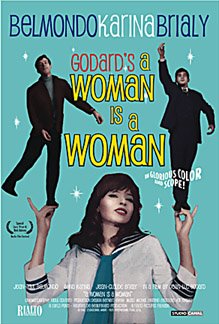
A Woman is a Woman (Une Femme Est Une Femme) (France, 1961) * * * 1/2
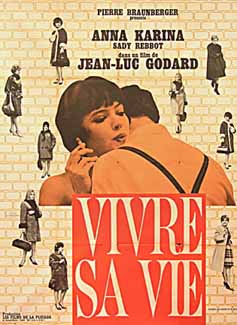
My Life to Live (Vivre Sa Vie) (France, 1962) * * * *
D: Jean-Luc Godard

This semester the University of Wisconsin Cinematheque is hosting the first half of a Jean-Luc Godard retrospective, this one, "All You Need is a Girl and a Gun," highlighting his films made before 1968. I have pledged to see as many Cinematheque films this year that I can; the summer only offered a brief series on contemporary African films as well as American road movies, of which my busy schedule just allowed me to see two in the latter series (Two-Lane Blacktop and Road to Morocco). This fall/winter they're also doing a series on the great Indian director Satyajit Ray, films of the 1910's, martial arts movies, and the Hungarian director Bela Tarr, whose seven-hour-long Satantango promises to be grueling and/or life-transforming.

I've always been ambivalent toward Godard. The first film of his I saw, Breathless, should have been the perfect introduction to the seminal New Wave director; instead, I was indifferent, and felt it was just an excercise in style--here is a "great" film that may have worn to threads with age. For Primer I also watched Contempt, which I loved, and which made me briefly consider that I was wrong to dismiss him, though I was already devoted to Truffaut, as though one had to take sides in that battle (I saw the two sides as "story" vs. "style"). Contempt pressed me to give Godard several more chances: Notre Musique, Les Carabiniers, Alphaville, Le Petit Soldat, Band of Outsiders, Week-End. Regardless of my varying reactions to those films, none of which I hated, by that last film I felt I had seen enough, and with Primer over, thought I could begin exploring other French directors such as Rohmer, Melville, and Rivette. Then, a few months later, the Cinematheque announced that its director of the season was Godard, and I was handcuffed to plunge.

Appropriately, the first film of the retrospective was Breathless.

The screening changed my mind. I was wrong to watch this at home. The tiny Cinematheque at Vilas Hall was "sold out" (all screenings are free, and naturally draw a mix of students, film buffs, professors, families, and hobos), and by the scheduled start-time the organizers were turning people away at the door. Consider that they could walk a few blocks to Four Star Video Heaven and rent it on DVD. But that's what I did the first time, and the experience doesn't compare; Breathless must be seen with an audience, and preferably--like this one--a very green audience.

When you go to the first film of the fall semester, you get a lot of freshman who are seeing, perhaps, their very first foreign film (or, at least, their first foreign film to not star Jet Li). You get the requisite unintentional laughter. That laughter changed rapidly as they began to laugh with Godard rather than at him: he was too quick for them. He was making a film for the young; he was only 29 when he made the film, after all. The infamous jump-cuts (removing frames of the film to create "edits" in the middle of a sequence) have been appropriated into weekly dramas on TV ("Homicide," notably); they pass almost imperceptibly now. No, it was Jean-Paul Belmondo, the crooked-nosed, impeccably immature young French actor who was the hit of the evening. Maybe it was how he was given to address the camera directly, or suddenly leap out of a taxi in order to lift up a passer-by's skirt, or maybe it was the fact that he kind of looks like Owen Wilson, I don't know. But whatever he dished in spoonfuls they were eating up. He plays a casual criminal--emphasis on "casual"--who seems to rob and point his gun for the joyful spirit of anarchy more than anything else. His girlfriend is played by Jean Seberg, who I just saw in a very different role in the Peter Sellers vehicle The Mouse That Roared. There, she was Hollywood, sexlessly glamorous. By contrast, Breathless seems to be the behind-the-scenes documentary of Seberg, catching her looking completely natural: there was one moment when she was merely climbing a staircase, and I had the strange feeling that she was unaware of being filmed. But that's the point: Godard is trying to transform the banal. The bravura setpiece of the plotless film is one long evening (and the following morning) spent in an apartment while Belmondo pleads for sex and Seberg dismisses him. He seems like a child at first, his pleas hopeless, but by the end of this stretch we see how dearly Seberg seems to care for him. Nevertheless, the nature of their relationship is constantly in question, and the famous finale is classic Godard cynicism.

The film's weakness is Godard's naive tendency to put a point on matters; his characters frequently underline what the film is about. "We always talked about ourselves but we should have been talking about each other." (Godard wrote the screenplay but Truffaut is credited for the story, which is pretty spare.) But what struck me about this second viewing is how deliberately vulgar it is: Godard was delighting in offending the older, straightlaced generation. His film points the way to the varying rebellions of the 1960's generation, the children of Marx and Coca-Cola, as he defined it. If you didn't get his film, if it was too violent, too anarchic--then you are the enemy; what's worse, you're old. There's still a little of that spirit in his most recent film, the otherwise solemn Notre Musique. (And I couldn't help but think that the extended scene in which Seberg interviews a renowned intellectual, and he disdainfully tosses off his world-summarizing pronouncements, directly, and probably unintentionally, parallels the scene in which Godard himself looks down his nose and makes pronouncements to a classroom of students in Notre Musique. He's finally become what he seemed to admire.)

"Groundbreaking" is the word for Breathless, but it doesn't offer that much more; but the well doesn't have to be that deep in the second film of the series, A Woman is a Woman, which is kind of like if The Umbrellas of Cherbourg had none of the songs. This "idea of a musical," as Godard once called it (thank you, program notes) stars Godard's muse, Anna Karina, as a young woman whose boyfriend (Jean-Claude Brialy) doesn't take well to her new obsession over having a baby. Distraught, she turns to another friend, "Lubitsch" (Belmondo again, who at one point, expressing his disgust, says he's going home to watch Breathless on TV). This is Godard at his most audience-pleasing, and expectedly, the Cinematheque crowd had a blast with it, treating it with as much enthusiasm as The Road to Morocco had received. Yes, Godard is witty here, and addresses the artificiality of the production as much as Bob Hope did, but there is a weird conceit that dominates everything: it's a musical with no music numbers. Well, there is one, within a set context. As Karina strips (her day job), she sings a song by Michel Legrand, who wrote the music to Umbrellas of Cherbourg and The Young Girls of Rochefort, and composed the scores to other French New Wave classics such as Agnes Varda's Cleo from 5 to 7. Even here, there's a conceit: each time she actually sings, the orchestration drops out of the soundtrack, and we're left with Karina's pale voice whispering the seductive words. Godard's attempt to sabotage the song somehow enhances it. Imagine what Marilyn Monroe could do with the technique. Of course, Godard is fond of screwing with the soundtrack, and frequently in A Woman is a Woman you can hear him playing with the mute button on the score. Here is sweeping music, here are the sounds of the street, here is the same sweeping music, here is the dialogue--Godard wants you to think about the process of creating a film, and wants to draw attention to the artificiality. He always wants to do this, which is why I always thought a little of Godard goes a long way, but I'm slowly changing my mind: you can be buffeted about from one Godard film rather deliriously. It's true, as the presenter said before the screening of Breathless, that each Godard film is radically different than the one that came before. True, he's always in the act of deconstructing, alluding, and sabotaging, but if you treat his films as cinema commandeered by Spy Vs. Spy, you can get in the spirit of things.

A Woman is a Woman is, in fact, a cartoon for adults. The peek-a-book nudity, the discussions about sex, the playful infidelity all suggest a tone which A Woman is a Woman cheerfully avoids: nothing here can be taken too seriously. My wife has picked this as her favorite Godard (the other, I think, is Band of Outsiders), and I can see why; no wonder she also loves The Young Girls of Rochefort. This is a lot of fun, and the Lubitsch reference is appropriate.

How perfect that it was on a double-feature not with a Jacques Demy musical but with the film's negative-image, My Life to Live. (It's even in black-and-white.) Here Karina is cast as a woman too pretty to be as desperate for money as she is; with hopes of an acting career dwindling, she turns to prostitution, but always with a philosophical attitude (this is Godard, after all): the situation, perhaps, will not be sad and desperate if she refuses to see it that way. Or perhaps not. The key scene here is when Karina talks to an acquaintance who resorted to prostitution to make ends meet, and eventually married a successful actor; the hopeful story is immediately offset by a shooting in the street, and a bloody victim staggers into the cafe before Godard cuts to the next "chapter." (The film is in 12 parts, with descriptions of the action before each.) Individualism can carry you so far, until you're set against another, stronger force, and the threat of violence hangs over this prostitute's life as it does in other treatments on the theme, such as Lodge Kerrigan's Claire Dolan. If the story is well-trod, at least the style is refreshing. Godard tones down his distracting styles, allowing you to lose yourself in the character's journey. That's not to say there isn't the Godardian, rigorously intellectual approach to camera movements. For a film that reveres the close-ups in Carl Theodor Dreyer's silent film The Passion of Joan of Arc, which Karina goes to see at one point, it deliberately keeps the camera distant, and in the opening cafe scene hides the faces of Karina and her husband, instead eavesdropping from behind as they discuss the end of their relationship, as though we're just sitting a table away. Karina is consistently isolated in the frame throughout, culminating in an abrupt final shot that is deliberately pathetic. Yes, it's a very sad film, but it's elegantly constructed, and reminds of Robert Bresson's Mouchette or Au Hasard Balthazar. It is a film that is so passionately made that it cannot be considered "depressing." I could watch Karina's seduction dance over and over: she tries to pick up a young man at a pool table by playing a song on a jukebox and dancing hypnotically around and around the room. I could use more Godard like this; it seems more essential, and seems to have more to say, than the later Godard experiments I've seen.
Cumartesi, Eylül 02, 2006

The Incredible Shrinking Man


The Incredible Shrinking Man (U.S., 1957) * * *
D: Jack Arnold

Every night on Turner Classic Movies is a theme night, and last night's was, somewhat inausipiciously, Jack Arnold Night. No slight to Jack Arnold, it's just that he's not frequently the subject of movie marathons. Best known, perhaps, as the director of The Creature from the Black Lagoon, the last of Universal's great monsters, Arnold also directed films as varied as The Mouse That Roared (the other film I watched last night) and Tarantula. He quickly retreated into television work, and his last credits include episodes of "The Love Boat."

The Incredible Shrinking Man might be his seminal science fiction film, and one of the most distinctive of the 1950's. For that reason, as a lifelong science fiction fan, this was a much overdue viewing. I already knew the ending, which is rather famous. It's everything that precedes it that was foreign.

Grant Williams turns in a surprisingly interesting performance as Scott Carey, a--um, white guy--who is sailing with his wife when he passes through a radioactive cloud (she's busy belowdeck, and doesn't suffer the exposure). He wipes some glitter off himself and doesn't give it much thought, until he goes to his doctor to find out why all of his clothes have lately seemed a couple sizes too large. "Have you been exposed to any radiation lately?" Actually, it's the combination of exposure to insecticide and radiation that caused this particular condition, which I suppose explains why other people just get, you know, cancer from radiation exposure. (So remember that combination, kids: DDT and radiation!) After a while he begins to look like Lily Tomlin in that big chair, and he's downright adorable, but he also feels like a freakshow, and takes solace with a midget carnival performer (April Kent) who, wouldn't you know, is just played by an actress also sitting in a big chair. He can't believe his luck, and neither can we. But as he prepares to cheat on his wife with someone his own size, the shrinking (which comes in waves) returns, and he becomes so small that his wife keeps him in a doll house, leading to the famous scene where he's attacked by his household cat. Which makes the viewer immediately wonder how his or her own domestic animal would treat the owner when suddenly shrunk to doll-size. Judging by the leisure activities of my own two dogs, I can only assume they would whip me back and forth and then chew until they found my hidden squeaker. At any rate, Scott is tossed into the cellar and now must contend with new problems--such as how to remove the cheese from the mousetrap, and how to avoid the giant tarantula.

All of which is redeemed by Richard Matheson's screenplay. Matheson wrote many of the most fondly-regarded "Twilight Zone" episodes, though among genre cultists these days he's best known for his novella "I Am Legend," which was filmed as The Last Man on Earth and The Omega Man (and was the uncredited inspiration for many an apocalyptic zombie film). I tend to regard Matheson as the genius who wrote Hell House, one of the creepiest haunted house novels ever written; he wrote the screenplay of the pretty-good 70's adaptation, The Legend of Hell House, which is ripe for a remake by someone other than Jan de Bont. Robert Osborne, introducing The Incredible Shrinking Man, cited Matheson as the guy who wrote What Dreams May Come, to which I reply by throwing a book at the TV. With Shrinking Man, Matheson treats the premise as a post-film noir science fiction film: there's no way out for the shrinking Scott, no cure to be found, and no martyred death, either. That's what makes this a cut above most genre SF films. Scott is forced to adapt to each new size on its own terms, and--as he directly observes in the film's voluminous voice-over narration--each time he shrinks he's forced to grapple with a completely alien world. The entire second half of the film takes place in the basement, as he waits forlornly for his wife to come downstairs, scavenges for food, makes a home out of a matchbox, and then, weak from starvation, struggles to climb toward a piece of cake that sitting abandoned by a window (for some reason). When he shrinks again, he can finally pass through the grate and walk outside into the vast jungle of his backyard--and here the film ends! Poor Scott tries to be an optimist about the whole thing, and the ending narration is optimistic, hopeful: he'll be a pioneer in one new world after the next, and soon the rest of the human race may be joining him, should they continue to experiment with new and strange sciences. The ending is actually very reminiscent of the end of The Time Machine, as Wells thrusts his time traveller ever forward, past the Eloi and the Morlocks into new future worlds, past the end of the human race. But the time traveller does so willingly. Scott has no choice, and will soon be exploring among the microcosmic.

Perhaps I've been watching too much film noir lately, but it all seemed very noirish, from the voice-over narration to the forlorn outcast walking past the nighttime carnival (think Nightmare Alley) to the despair of finally being cornered by one's Fate, and resigning oneself to the end. But, of course, he doesn't end. The final line is remarkable, because it is, at once, hopeful and terrifying: "I still exist!"

Sergio Leone's Man with No Name Trilogy


Roger Ebert points out, in his "Great Movies" review of The Good, the Bad, and the Ugly, that the famed "Man with No Name Trilogy" by Sergio Leone isn't really about a man with no name, and could possibly be about 3 different characters; Eastwood is "Joe" in the first film, A Fistful of Dollars, "Monco" in For a Few Dollars More, and "Blondie" in The Good, the Bad, and the Ugly. Well, yes. But Blondie is clearly just a nickname because the guy has no other name to go by. Furthermore, we can assume by the titles that Few Dollars More is a sequel to A Fistful of Dollars, so the always-poncho'd Eastwood is playing the same fella; the fact that he uses a different name in each film implies they're only aliases. He is, after all, a cold-blooded killer.

The fact that he is a cold-blooded killer, yet by default the hero, is just what makes the Dollars/No Name trilogy so much fun. He frequently shoots people in dishonorable ways simply because they'd kill him first. Sure, he kills for the money, but he is hunting down the grimiest, sweatiest, black-toothed villains in screen history.

I saw Fistful of Dollars many years ago, on TV, cropped, and with commercials, I'm sure. I found it exciting at first, and then sort of dull. I always wanted to return to Leone, but thought I'd grown out of it before I got a chance. Like most folks these days, I didn't think I had much time for Westerns, not with all the great novels to read and the acquired pretensions of college. It was only when I started my "Primer" project of watching first 100, then 500 films, that I came to love the genre. I even loved John Wayne movies, something that seemed as likely as suddenly coming to love Elvis. But it wasn't Wayne that I loved so much as his directors and the vehicles in which they placed him: Stagecoach, the iconic and prototypical Western, is thrilling thanks not just to Wayne, John Carradine, and the other players, but because John Ford knew how to pace the action with the nostalgic prairie scenes, just as he does with The Searchers; Red River, which I will always think of as "my favorite Western except for the last, terrible ten minutes," glows with Howard Hawks' striking use of characterization, which he applies to more sardonic effect in Rio Bravo. All of these films I adore, in addition to the non-Waynes Destry Rides Again, Seven Men from Now, Winchester '73, and The Gunfighter. Now I'm more of a typical film buff, in that I'm always open to watching a Western when it comes on TV.

The Leones work much better with all that preface of film history. He subverts every Western trope, strips them (mostly) of their nostalgia, and gets right down to the nitty-gritty. When you see Eastwood, his unshaven face that seems to be chiseled, the squint, the teeth chomping down on the cigar (always), you're amazed at how iconic and original the image is, like a moment out of one of Kubrick's 60's films, instant film history. It arrives out of nowhere. Yes, James Stewart was playing some cold-blooded folks in Anthony Mann films, but at least he had a stuttering, soft-spoken history in films with which audiences could identify; Eastwood, inexplicable, is capable of anything.

A Fistful of Dollars--like all the "spaghetti Westerns" (a genre that began here)--was an Italian production set in the American West, filmed in Spain and Italy, and entirely dubbed. The dubbing was a thing of necessity for Italian productions: low-flying planes near Rome's Cinecitta studios made live recording virtually impossible. Regardless, Eastwood provides his own voice on the English track, and his words match his lips, so it's not too distracting. (It helps that his lips don't move much, with that cigar perpetually in his mouth.) The film, like The Magnificent Seven, is a Western remake of a Kurosawa samurai film. While The Magnificent Seven borrowed just the outline of The Seven Samurai, Leone's film copies Kurosawa's Yojimbo very closely--so much so that if you'd only read the screenplay, and didn't bear witness to Eastwood, Leone, and composer Ennio Morricone, you'd think the film unremarkable. A man whose only talent is killing arrives in an isolated town run by two rival gangs; essentially, a powderkeg. The killer, desperate for cash, decides to maximize his profits by working for both sides, playing one against the other. Eventually, the plan backfires, and he's beaten and tortured to death's door, only to recover just enough strength to enact a revenge. The reason Kurosawa's films were among the first Japanese films to become popular in America is that his characters, setting, and style were not so foreign; films such as The Hidden Fortress deliberately transposed American genre trappings into Eastern culture, so naturally they can easily be adapted back into a Western culture. Leone's love of American genres rivalled Kurosawa's, and so A Fistful of Dollars, this bizarre Euro-American-Japanese hybrid works like a charm.

But let's get to the point: it's Leone's show, and his distinctive over-stylization, defined by its quick and detailed cutting, so that every action scene is dissected into pieces like the shower scene in Psycho, is matched only by Morricone's score, which deliberately imitated the form of pop music. Morricone's music, when heard in full on a soundtrack CD, is actually just a really solid Western score, with plenty of harmonica, fiddle, and even a square dance number. Of course, no one remembers that. It's the opening titles that Morricone made so iconic; animated--showing gunslingers blowing each other away--they're set to Morricone's whistling Western pop song with no lyrics except for the occasional shout of...something, I'm not sure ("Whip that flag?" "Wave that bat?"). Originally conceived as a lullaby, Morricone transformed it into one of the most famous pieces of Western film music of all time, only surpassed by his theme to The Good, the Bad, and the Ugly.

For all this, Fistful does drag a bit, even to these adult eyes. (To be fair, so did Yojimbo.) The sequel, For a Few Dollars More, has nothing to do with the sequel to Yojimbo, which is probably a wise choice, as Sanjuro would not have made for great Leone; instead, it slightly improves on the original by keeping one's interest held throughout. Lee Van Cleef plays a bounty hunting rival to Eastwood's returning gunfighter--they're so well-matched that in the film's most memorable sequence, they face off in a deserted townsquare at night by simply shooting at each other's hats, like two animals snapping their jaws to prove their ferocity without actually inflicting harm. They're both pursuing "El Indio" (Gian Maria Volonte), a psychotic killer recently escaped from prison, and plotting a major bank heist. (For some reason, the biggest bank in the Old West, and his intended target, is in a deserted village with no discernable commerce.) After a long courtship, Eastwood and Van Cleef reluctantly team up and hatch a plan: Eastwood will infiltrate El Indio's gang as one of their own, while Van Cleef will wait in ambush near the bank. How their plan unfolds--and unravels--is one of the real joys of Fistful, so I won't spoil it. Needless to say, it all comes down to another shootout in the street, but this time it's between Van Cleef and El Indio, who will both draw when a tiny music box winds down. With For a Few Dollars More, you can sense Leone attempting something slightly greater, with deeper characterization and more emotional impact. For one thing, the villain has a crippling anguish over something in his own history, which is gradually revealed through the course of the film--a technique that will be repeated, to better effect, in Leone's Once Upon a Time in the West. Eastwood pretty much sits the climax out, though he has a great final scene.

When Leone made the final film in what was now a "trilogy," the first two films had been such an international success that he had a much larger budget with which to work. Appropriately, the scope of the film is expanded: at almost three hours in its recently-restored "director's cut," it's a veritable epic. The Good, the Bad, and the Ugly are defined on-screen in the opening twenty minutes of the film (a really long opening credits sequence, really). Surprisingly, Van Cleef here returns as "the Bad," and it took me a space to realize he's not playing the same character as in the last film; a relief, really, as that character would have had to take a pretty tragic turn to become this bad--on the trail of a treasure, he kills innocents in cold blood in the opening minutes of the film. "The Ugly" is, unflatteringly, Eli Wallach, the character actor who had played the villain in The Magnificent Seven. A scoundrel with a preposterous criminal record, he works with Eastwood to perform a scam on one town, then the next: get arrested so that Eastwood collects the reward, prepare to get hanged, and get freed by Eastwood at the last second, so they can split the cash. The problem, as Wallach belatedly realizes, is that too much of the scam depends upon Eastwood following through on his side of the bargain, and as Eastwood leaves Wallach high and dry in the middle of the desert, the words "The Good" brand Eastwood as he prepares to ride off, a devilish grin on his face. This is Leone's world, where there is no purity to be found, but shades of gray at best.

One of the reasons that The Good, the Bad, and the Ugly is my favorite of the trilogy is that it's a quest narrative, and I'm nothing if not a big sucker for those. Eastwood, Wallach, and Van Cleef are all after some stolen gold buried in a Confederate grave. Eastwood and Wallach both stumble across the gold's location, although because of (improbable) circumstances, neither can find it entirely on his own, forcing them into an awkward partnership, each ready to betray the other should the opportunity arise. Van Cleef has been hunting the gold from the start, and smugly attempts to manipulate the two killers to reach it. That's all there is to the plot. What's left is an episodic journey in which positions of power shift among the three, and we see a Wild West torn to tatters by the Civil War. Long stretches pass without shootouts, but when they come, they're exciting as hell. The final showdown is stylized--and drawn out--to such an extent that you think Leone wanted to make this the Last Spaghetti Western Ever. It wasn't, but it's still the best.

The keen interest in amorality gives the Leone Westerns a direct connection to the heritage of American Westerns, despite the fact that his use of amorality is meant to subvert that heritage. After all, the best Hollywood Westerns were existential dramas, in which the "right thing to do" isn't always so obvious, particular when the Law is so often in a helpless position, if not completely absent. On one end of the spectrum, there's a B-movie like Tin Star, with Anthony Perkins as a spineless sheriff who needs to learn from Henry Fonda to be a bully, if not a killer, in order to save the town from bandits and act as a force of good. On the other, there's the John Wayne of Red River, a good guy who becomes the villain when his ideology and anger conquer his reason and his morality. More distinctly existential is The Gunfighter, with Gregory Peck as a wanted man who's reformed his gunslingin' ways, but can't return home to the girl he loves, since every would-be Billy the Kid wants to be known as the one who finally shot him: dread drapes this film even more effectively than in High Noon.

But yeah, the heroes of Leone's Westerns might be wounded by a trauma in their past, as Charles Bronson's character is in Once Upon a Time in the West, but they don't anguish over whether or not to shoot somebody. In that sense, Leone's films belong to the second stage of Westerns, dominated not just by his films but by Sam Peckinpah's. In this stage, the life of violence is the issue to be explored. (I see a third stage to be vaguely defined by McCabe & Mrs. Miller and the recently-cancelled HBO masterpiece, Deadwood.)

My wife was quick to point out that there's no prominent female characters in The Good, the Bad, and the Ugly, and the women are relegated to roles as extras; for this reason, she prefers Once Upon a Time in the West to this film, though she enjoyed both greatly. I think Leone thought women would complicate the already stripped-down motivations of the characters: these guys are after money, and women would give them something else to fight over. At three hours, The Good, the Bad, and the Ugly is astoundingly simple--as all Westerns are. Nothing Dickensian about the Old West. In the vast, uncluttered landscape that Leone imagined, men stand in silhouette in clouds of dust, wait for the hyena-like Morricone music to suddenly silence, draw, take the cash, and ride off. Amazing how many playful permutations Leone could find in these three films, or that he could turn it all into something resembling profundity! There's no shame in loving these films.

Perşembe, Temmuz 20, 2006

Some Capsule Reviews

My summer moviegoing experience so far has been limited, due to my limited funds and a general lack of interest in the films that are coming out. But occasionally we catch something we can't afford to miss (like A Scanner Darkly, review here) or run over to the budget theater to see something old and on the cheap...which explains why a couple of these films are coming out on DVD soon! Oh well. It's a three-star summer, from what I've seen, but hey, I haven't seen Little Man, so maybe the true masterpieces are just under my nose.

Inside Man (U.S., 2006) * * * 1/2
D: Spike Lee

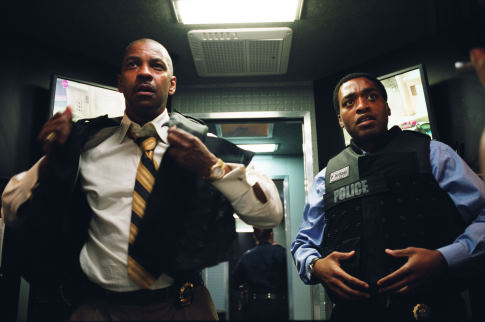
Spike Lee "sells out" in what is actually one of the best films he's ever made. It's no Malcolm X or Do the Right Thing, but man, is it more focused and tight than Bamboozled. A heist film for adults, many of the critics said; I guess that's because you never really want the heist to end. You want the standoff to go on forever, because the cop (Denzel Washington), his partner (Chiwetel Ejiofor), and the robber (Clive Owen) are so much fun to watch. There's also Willem Dafoe in what's actually an extension of his performance in The Life Aquatic: another light comic role in which he subverts the Dafoe typecasting. The idea is that Owen is holed up in a bank with his fellow crooks and a slew of hostages, and Washington has to figure out why Owen seems too smart to attempt the purported scheme--a demand for a plane--and what the real scheme is. Seriously, I could watch Washington and Owen try to outthink each other forever. And there's such great character humor: Lee clearly loves New York, and wants to show every sort of person who would choose to live in the city post-9/11. In a clever twist, the film reveals that it's really about the nature of profiteering, as Jodie Foster's attorney and Christopher Plummer's banking CEO prove to be more immoral than the thief. Love the Bollywood music that plays during the opening and closing credits, too. How I wish all Hollywood thrillers were this smart.

Silent Hill (U.S., 2006) * * *
D: Christophe Gans

Yes, I even liked Silent Hill. Got a problem with that? Some people hate this film, and I sort of understand why. For one thing, Roger Avery, who co-authored Pulp Fiction, wrote the screenplay to Silent Hill, and Christophe Gans directed--his previous film was the delightful French genre hybrid Brotherhood of the Wolf (which answered the question: what if James Fenimore Cooper wrote a werewolf film set in Europe?). So expectations were high. For another, some of the dialogue is really bad, and the ending is frustrating and bizarre. But the ending is also original, as is much of the final act, which made me sit forward in my seat and wonder where the hell this new, brash, exciting horror film came from. It was certainly strikingly different from the mostly-bland beginning and middle, which depressingly sticks so close to the video game upon which it's based that the demonic, Clive Barkerish beasties get introduced as though they're the main characters. And much of the early scares aren't scary at all, since the CG is so transparently fake. But the atmosphere--whitish ash floating like snow in an abandoned mining town in an alternate dimension--is mesmerizing, and I love the gimmick of the siren that blares when everything's about to go black (literally--the screen goes black for several seconds, which is effectively chilling) and turn hellish. It just seems goofy that there are such strange, video-gamey clues for the heroine to follow, but I was impressed that the film actually offered an explanation for this and all the other film's gimmicks. The explanation comes in a flashback that looks like it comes straight out of a 70's Satanic exploitation film--it looks like it's been transferred to Super-8 and back again. There's actually a story to this film, and quite a lot of interesting ideas and subtext; the problem for many viewers is that you have to wait until the end to get it all, and I think many weren't paying attention by that point, or had left the theater. In fact, this is a really rare artifact: a good horror film. And twice as rare: it's based on a video game. Imagine how good it could have been if it weren't. A few little revisions to the script and it could have been a classic.

Strangers with Candy (U.S., 2006) * * 1/2
D: Paul Dinello

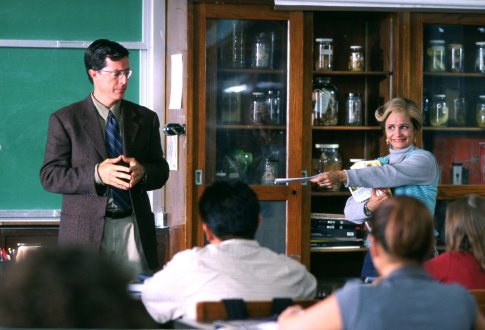
I used to love the Strangers with Candy TV show, which existed very briefly on Comedy Central around the same time that the mainstream media started taking notice of the show that preceded it, The Daily Show with Jon Stewart. Stephen Colbert was on both, appearing in Strangers as a married science teacher who's having a secret affair with the art teacher "with the mind of a child!" played by Paul Dinello. Both are credited with writing this feature spin-off, alongside the key creative force behind the concept, Amy Sedaris. Sedaris plays Jerri Blank, a middle-aged high school dropout who turned to prostitution and drugs, was thrown into prison, and finally returned home to find her father in a coma. She's told by a doctor (Ian Holm, for some reason) that the only way to help her father is to return to her old life, so she goes back to high school and tries to pick up exactly where she left off. The plot involves a school science fair, and it's all dispensable and padded; the important thing is that the project is a very, very close parody of 70's Afterschool Specials, and dispensing lots of very bad advice along the way. (Blank is a racist, prone to sudden violence, and comes on to everyone of either gender.) It's understandably a one-joke comedy, and the film doesn't really need to exist--the TV show got the job done--but it's still pretty amusing. For all of Sidaris' elastic contorting, the standout of the cast is actually Greg Hollimon, as Principal Onyx Blackman--sit through the ending credits as he gets the last laugh.

Superman Returns (U.S., 2006) * * *
D: Bryan Singer

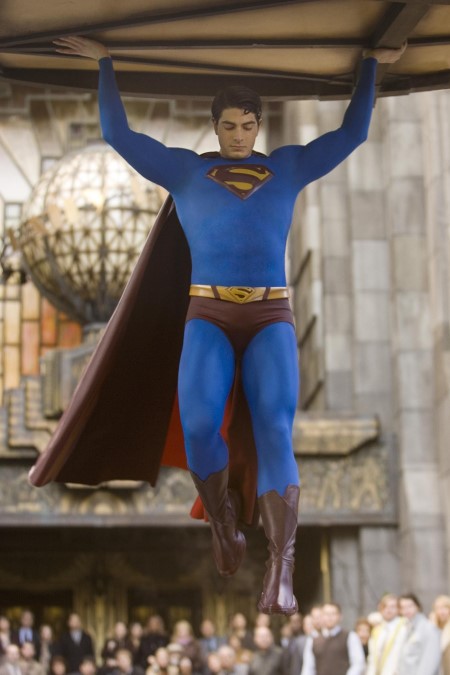
Brandon Routh does an amazing impression of Christopher Reeve in this, positioned as the ultimate summer movie, but ultimately drowned by Captain Jack and the Pirates of the Caribbean. The fact that Routh looks and acts so much like the young Reeve of the first, Richard Donner-directed Superman--and that, in choice moments, Kevin Spacey's Lex Luthor is a dead ringer for Gene Hackman's--should tell you everything you need to know about Singer's approach. Singer worships Donner's film, and that's why this film exists. It's like someone from Ain't It Cool News got a chance to direct a Superman movie, so here's Marlon Brando reprising his role as Superman's father (thanks to unused footage from the first film), a scene in which Superman takes Lois Lane (Kate Bosworth) on a romantic night flight, and references a-plenty to just about everything in the prior film. He also pretends that III and IV never happened, and I do sympathize. But because of that slavish devotion to Donner, there's a plasticine quality to the film, and it never really comes to life in the way that Singer's X-Men films did. He's just too reverent, and thus too removed. But there are a few brilliant touches, like the close-up of Lois Lane's feet as she slips off her high heels to board Superman's boots, or the sheer majesty of Superman shooting into the sky to stop a plane set ablaze by a space shuttle's rockets. It makes up for the fact that the actors are just a little too young, that nonsensical Luthor plot and the plodding, unattractive final act.

X-Men: The Last Stand (U.S., 2006) * * *
D: Brett Ratner

The final X-Men installment fell to Ratner, director of the Rush Hour films, when Singer fled to Superman V. That's not as bad as every comic book geek the world-over dreaded. Ratner gets it mostly right, particularly in the film's final shot, which involves supervillain Magneto (Ian McKellan) alone in a park. And I also liked the romantic triangle between teenagers Iceman (Shawn Ashmore), Rogue (Anna Paquin)--who can't touch her boyfriend, or she'd kill him against her will--and cutie Kitty Pryde (Ellen Page), who passes through walls, and who was my crush as a kid, however pen-and-ink. It's true that there's too many characters by this point, and that the whole Dark Phoenix thing isn't nearly as interesting, or as complex, as it should have been. But Hugh Jackman is still the perfect Wolverine, and how sublime that he gets to fight alongside a gymnastic Kelsey Grammer (as Beast) in this one. It's not as self-reverent as Superman Returns, and so it's just a little more fun.

Pazar, Temmuz 16, 2006

A Scanner Darkly


A Scanner Darkly (U.S., 2006) * * * 1/2
D: Richard Linklater

After a quarter century of cinematic adaptations, they finally got Philip K. Dick right.

The first came out just after Phil's death, in 1982 (I'll refer to Mr. Dick as Phil, as most of his fans do--you read enough of his novels, which are so similar and so autobiographical, that you feel you know him); deeply sad, given that he spent his entire life struggling for some kind of monetary success. That film was Blade Runner. Based on 1968's Do Androids Dream of Electric Sheep?, a novel about a police detective assigned to hunt down runaway androids--he tests them by using a device that detects the subject's ability to empathize, although his morals are complicated when he begins an affair with one of them--the film was about 25% Phil, 75% Ridley Scott. As a Ridley Scott film, it's eye-popping and mesmerizing, and certainly one of the most intelligent science fiction films ever made. It's not exactly Philip K. Dick, though. Early scenes mimic the book's dialogue directly, but key elements are omitted (electric sheep, the martyr Mercer on television), and the resolution, while it works for the film, draws an opposing conclusion about the difference between the human and the machine: Phil thought there was a concrete and important difference, Blade Runner blurs the line. The philosophical divide isn't detrimental to the adaptation, just interesting--but it's certainly not Phil.

The Schwarzenegger/Verhoeven action film Total Recall began a disturbing trend in Hollywood to adapt Phil's short stories rather than his novels, and by doing so, to pull just an idea of Dick's and then turn it into something more mainstream, less interesting. While Total Recall (from "We Can Remember It for You Wholesale"), when placed against the rest of Schwarzenegger's films, comes across like a David Mamet game of cons--whatever you think is real, isn't--and thus compares pretty favorably, you can't get around the fact that Phil never would have written a story with someone like the Governor of California as his protagonist. His heroes were middle-aged, divorced, out of shape, pill-popping schlubs not too dissimilar from himself. To keep the Mamet idea going, William H. Macy would be a much better PKD hero than Schwarzie. And a PKD hero wouldn't even know how to use a gun, though he might have some pointed at him.

1992's Barjo, a French film directed by Jerome Boivin, is actually based on one of my favorite PKD novels, Confessions of a Crap Artist (and Phil, while he lived, was always appreciated more in France than his home country). Crap Artist was the rare Phil "mainstream" novel (i.e., no science fiction elements) that actually got published in his lifetime. He always wanted acceptance outside of the SF genre "gutter," but publishers weren't interested. In many cases, the publishers were right: novels like UBIK, The Three Stigmata of Palmer Eldritch, and The Man in the High Castle are a lot more interesting than his studies of failed marriages, The Man Whose Teeth Were All Exactly Alike, Mary and the Giant, and Puttering About in a Small Land. But Confessions of a Crap Artist is fascinating and deserved to be set apart; adapted into a film, I'm not so sure. Barjo is fairly faithful, but struggles to emphasize that the source material was by a science fiction author, and so deliberately inserts fantasy elements toward the end. It would have been more interesting directed by Cassavetes. It's a forgettable film.

So is Screamers, based on one of the more popular Phil short stories, "Second Variety." A somewhat faithful adaptation, Screamers, starring Peter Weller, is a B-movie set in a war-ravaged world where machines of war are disguised as innocuous things--little girls, teddy bears--in attempt to lull the soldiers into a false sense of security. The machines attempting to adapt to the sympathies and emotional vulnerabilities of the soldiers is the key satirical element of the story, and it's here, but all awash in macho Aliens-inspired nonsense. Three more adaptations of PKD short stories shortly followed: Impostor with Gary Sinise, which began as a short film for an aborted anthology, then unwisely padded to full-length; Paycheck with Ben Affleck, directed by John Woo, who, in an interview, said he wanted to adapt Philip K. Dick because he really liked Philip K. Dick movies like Blade Runner and Total Recall (I think he also called Impostor a "novel"), which should tell you everything you want to know about this flop; and Minority Report, the most distinguished Phil adaptation since Blade Runner, and a pretty smart Steven Spielberg film...still, the film, to this viewer, seemed more like Spielberg's attempt to show how hard-edged he could be to refute all his A.I. critics, and it really had nothing to do with Phil's story, which was pretty minor PKD anyway.

Now, finally, we have another adaptation of a novel, with Richard Linklater's A Scanner Darkly. Phil's novels were so often miles ahead of his short fiction--the bulk of the latter written in the 1950's, as Phil tried to figure out how to handle the science fiction genre. His novels, such as Time Out of Joint, Martian Time-Slip, Flow My Tears, the Policeman Said, and the VALIS trilogy, are considered landmark novels that, with Heinlein and Bradbury, validated science fiction as a potential forum for great literature. (I don't enjoy Heinlein, but I'm just quoting the consensus.) A Scanner Darkly, published in 1977 but intensely written and revised for several years prior, is the beginning of the final phase of Phil's career, as he deliberately attempted to fuse his literary aspirations with SF. Phil's novels were so trippy and featured so many (fictional) drugs that fans often assumed he was a drug-advocating prophet like Timothy Leary; indeed, for a while in the late 60's, his life was not unlike that of the characters in Scanner--which must contain many autobiographical elements--as he lived with people half his age in Berkeley, pursued unobtainable dark-haired girls, and popped pills to keep himself writing through the night, because an advance from a publisher meant he could eat for another week. When he died in 1982 it was from a heart attack, but it's likely he would have lived much longer if he hadn't worn himself ragged with the drugs he consumed during the 60's, and Scanner is like a self-aware, self-written obit a few years before the fact. (In the epilogue, which is copied in the ending credits of this film, Phil includes himself in a list of drug casualties: "Phil, permanent pancreatic damage.")

Richard Linklater is best known for Slacker, Dazed and Confused, and School of Rock. His career is one of mainstream, crowd-pleasing films (such as the remake of The Bad News Bears) produced in order to fund smaller, riskier films (such as this one). The direct predecessor of Scanner is his film Waking Life, which was filmed entirely in live action with actor Wiley Wiggens (from Dazed) and a large cast of professional and non-professional actors--and some professors who were not acting at all, but simply lecturing--then animated the entirety in a computer using a rotoscoping process ("rotoscoping" is animating directly over live action, and dates back to Snow White and the Seven Dwarfs). Each section of the episodic film, constructed to resemble a dream in which the protagonist is slowly becoming conscious, was animated by a different animator, giving each scene a distinctive character. I was lucky enough to see Waking Life at its premiere at Sundance in 2001. Linklater, visibly nervous, if not terrified, introduced the film by stating that those in the audience on drugs might appreciate it more than the sober ones. He revealed later that he had only seen the film in its finished state just before the screening at the Eccles theater; it was a last-minute deal and he was afraid it would be a fiasco. It received a standing ovation, and he seemed relieved when it was over.

At one point in Waking Life, Linklater himself appears, to recount a strange story of Philip K. Dick's--not one that Phil had written, but one that had supposedly happened to him. I saw this scene just a few minutes after thinking, "This movie is really like a Philip K. Dick novel." Then I knew that if Linklater ever adapted PKD, he'd be one of the few to get him right; he was tapped into the sensibility already, and had just announced himself as an admirer. I was sick of miserable film adaptations of forgettable short stories, and wanted something that really captured the semi-comic, paranoid flavor of PKD. It was announced a few years later that he would be doing A Scanner Darkly, and what I saw last night, when the film came to Madison, was almost exactly what I knew the film would be. The animation process of Waking Life, which has threatened to become a cliche given its mundane use in investment banking commercials, is a perfect fit for Scanner, giving everything a subjectively trippy, floating look, and underlining the fact that what you are seeing might not be real, because you're seeing it through a drug addict's eyes. The casting is perfect: you may not think much of Keanu Reeves, Woody Harrelson, Winona Ryder, and Robert Downey Jr., but they are perfect for these wasted, conspiracy-minded stoners.

I should back up: A Scanner Darkly is a novel about drug addiction, and the science fiction elements are few but essential. Narc "Fred" goes undercover as Bob Arctor, living with two unhinged addicts, Barris (Downey Jr.) and Luckman (Harrelson), while dating the frigid Donna (Ryder). Thing is, only the highest in the chain of command know that Fred is Bob Arctor; while in the office he wears a "scramble suit" which projects a kaleidoscope of different features, disguising himself from his fellow agents. And as a result, most of his fellow agents are convinced that Bob Arctor is the chief supplier of Substance D and the central target of their investigation. As an undercover agent, Fred/Arctor pops pills of Substance D (or "Death"), which slowly splits the brain into two hemispheres and turns them against each other. Eventually, Fred begins to forget that he's really Arctor, and as he reviews tapes of himself with Donna, Barris, and Luckman, he begins to forget that he's spying on himself. The final act of the film depicts a chilling deterioration, and, typical of PKD, characters that were seemingly helpless suddenly prove to be in command, if not directly puppeteering the protagonist.

Linklater's film is one of the most faithful book-to-film adapations ever made. If any criticism can be levelled, it's that it's not faithful enough, as absurd as that sounds. To those who haven't read the book, it might not quite come across that Fred is beginning to forget that he's Bob Arctor, and this moment occupies so little screen time that it lacks some of the impact it should have. (When you're reading a novel, you're constantly informed of a character's inner thoughts, which makes a book about split personalities so tricky to adapt.) But what's here is amazing. He captures the conspiratorial, inane, funny but unnerving conversations among the mentally unhinged, almost word for word from the book. (My wife just read it, so with the book fresh in her mind, she was able to confirm this.) Phil, like his characters, had a way of super-analyzing a moment or an idea beyond reason, until it either fell apart or turned against itself, and I've never seen that captured in a film as it is in A Scanner Darkly. The animation eerily looks like live action most of the time--Reeves looks like Reeves, etc.--and although it justifies the medium less often than Waking Life did (the scramble suit being the most spectacular use of animation), the overall queasy look of the film is essential to the point of view of Agent Fred/Bob Arctor. In fact, this is probably not a film you want to watch when you're sick; it could only exacerbate the problem.

While Charlie Kaufman (writer of Being John Malkovich and Adaptation) wrote a screenplay based on Scanner, I don't regret his absence from this film. As much as I admire his work, Kaufman would be better suited for any other Phil novel--put him on VALIS, please. And according to a recent interview, Scanner was not Linklater's first choice, but wanted to adapt something else by PKD. In fact, he's perfectly suited for the material. Scanner, the book, does have some traits in common with Linklater's films Slacker and Dazed and Confused; they both have minimal action and quite a lot of talking about nothing. Linklater understands the SoCal world of the lethargic addicts, hanging out on sofas talking about bicycle gears, or testing out homemade silencers in the backyard. Kaufman is almost too anxious for material like this. He would speed everything up, cut it to pieces and reassemble it in a different order. That's why he's better suited for VALIS, a novel in which Phil was doing that to his own life, and inserting science fiction into the mix in attempt to make sense of it all.

Watching this with an audience was deja-vu; it was like watching Fear and Loathing in Las Vegas on its opening day. Terry Gilliam's film was another adaptation of a book that was supposed to be impossible to adapt, and he took a similar approach: be rigorously faithful. Both films and books focus on hallucinating, paranoid narrators you cannot trust to tell the straight story. And both audiences were baffled, kind of turned-off for the most part--except for a few who knew they were witnessing the birth of a cult film, and something they'd need to watch repeatedly to better appreciate it. Give Scanner a few years, and watch the audience multiply like imaginary aphids.

Cuma, Haziran 23, 2006

Eolomea

Eolomea (East Germany, 1972) * *
D: Herrmann Zschoche

I don't know if I love and adore this film or not.

Any attempt at objectivity--never mind that criticism isn't objective--would reveal this East German science fiction film from the early 70's to be plodding, with a constipated story that continually proves to be less than it seems to be, and some of the most ridiculous period trappings you can imagine, including psychedelic light-show visuals that emulate 2001: A Space Odyssey (but unlike Kubrick's film, are unconvincing and fail to be fully integrated into the environment of the film), a nutty lounge soundtrack that never matches the action, and perhaps the most unintentionally hilarious slow-motion shot of two lovers running toward each other with open arms across a long beach. (You've seen that shot parodied a thousand times, but here it is, delivered straightfaced, and it couldn't be any funnier.)

On the other hand, most of those criticisms endear me to the film. Greatly. Only the plot I can't forgive.

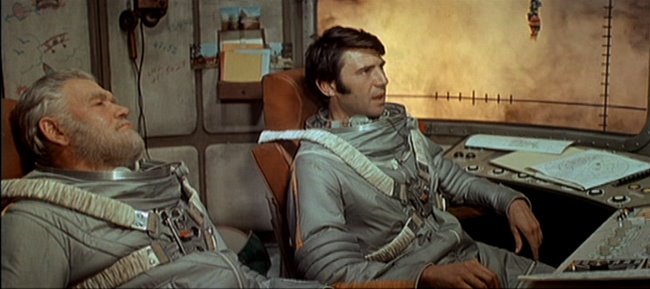
The plot: some spaceships are reported missing from a space station deep in the cosmos, and on Earth a young female scientist investigates the disappearance by questioning a smug, mysterious professor who knows something about a project called "Eolomea." Eolomea, it turns out, is the nickname for a deep-space object that may be a new, unexplored world, or a supernova, or who knows what (apparently the scientists aren't that good). The ships have actually been dispatched to find Eolomea and discover what exactly it is, although it's so distant that they may never return. Just before things get too interesting, the scientist and her team, arriving at the space station, find that the ships haven't left for Eolomea yet, but are just now about to leave. (That's right--nothing has actually happened in the film so far. Sorry to get you interested.) And it takes forever to get to this point in the film, because we've also been following, in flashback, the history of one of the two men manning the space station, a captain who fell in love with the female scientist on the Galapagos islands, and now keeps a pet turtle in his cabin to remind him of those halcyon days. A nice touch, a propos of nothing. As the film ends, this fellow decides to join the team journeying to Eolomea, leaving his life behind for good.

There is some nice material in here about missing the shining rays of the sun and the cool waters of the ocean, to leave it all for what the black vacuum of space. But space itself looks pretty exotic, what with all the psychedelic oil-in-water lightshows (you expect the Grateful Dead to begin performing whenever these cut in). I actually dig this Barbarella stuff. I even dig the cheesy lounge score. I even kind of dig the aforementioned hilarious slow-motion love scene.

It's a science fiction movie of the 70's, and it is exactly the kind of science fiction movie, pre-Star Wars, that you always think you know about, but have never actually seen. All the cliches are here. It's trippy. It's talky. There's a big chunky robot that serves drinks. There's even an astronaut who gets infected by some kind of "shadow" spore, but that's never really explained, nor does it have much to do with the plot.

The plot is the problem. There just isn't one. It's an idea: this film will be about exploring the great unknown, like a cosmic Lewis & Clark. But nothing actually happens, and all the talking leads nowhere.

But, man, it's a German science fiction movie from the 70's, with fairly decent special effects and set design that recalls French SF graphic novels by Moebius and other Metal Hurlant artists of the 70's and 80's. If you even know what that last sentence meant, you should probably see this film. Otherwise, it's just another relic of a very, very strange time in cinema that will never come around again.

Çarşamba, Haziran 21, 2006

LeRoy, Talma, Bosco

My short story "LeRoy, Talma, Bosco," which I wrote a few years ago, is one of the short stories for June at Dogmatika.com. You can read it here.

It's not a great story, but it's nice that it's out there. The title comes from a turn-of-the-century poster advertising a magic & comedy act; LeRoy was the magician, Talma his assistant, and Bosco was a heavyset comedian. I had it hanging above my computer for years while I lived in Seattle and Salt Lake City, and when I had writer's block I used it as inspiration for a story (although only the first two pages were written; it took a few years to go back to it, figure out what it was about, and finish it). The whole thing about the Pekingese comes from watching the Westminster dog show and being amused by their squat appearance and I-dare-you-to-like-me grooming. They look like walking carpets.

Pazar, Haziran 18, 2006

The Primer 500

Here were the 500 films I watched as step two in my ongoing film education. Some I'd seen before, but were included because of the circumstances--for example, watching 2001: A Space Odyssey on the big screen is like seeing it for the first time, as was watching Lawrence of Arabia in 70mm!

1. 8 1/2 - Fellini, Federico 1963
2. Throne of Blood - Kurosawa, Akira 1957
3. Notorious - Hitchcock, Alfred 1946
4. Kiss Me Deadly - Aldrich, Robert 1955
5. The Umbrellas of Cherbourg - Demy, Jacques 1963
6. The Red Shoes - Powell, Michael & Pressburger, Emeric 1948
7. High Noon - Zinnemann, Fred 1952
8. The 400 Blows - Truffaut, Francois 1959
9. Sunset Blvd - Wilder, Billy 1950
10. The Bicycle Thief - De Sica, Vittorio 1948
11. Wild Strawberries - Bergman, Ingmar 1957
12. Beauty and the Beast - Cocteau, Jean 1946
13. Ballad of a Soldier - Chukhraj, Grigori 1959
14. The Discreet Charm of the Bourgeoisie - Bunuel, Luis 1972
15. Breathless - Godard, Jean-Luc 1959
16. White Heat - Walsh, Raoul 1949
17. On the Waterfront - Kazan, Elia 1954
18. Le Million - Clair, Rene 1931
19. *Corpus Callosum - Snow, Michael 2002 (screened with the director as part of the Wisconsin Film Festival)
20. A Hard Day's Night - Lester, Richard 1964 (screened with film critic Roger Ebert as part of the Wisconsin Film Festival)
21. The Manchurian Candidate - Frankenheimer, John 1962 (screened with film critic Michael Wilmington as part of the Wisconsin Film Festival)
22. Punch-Drunk Love - Anderson, Paul Thomas 2002
23. Le Voyage Dans La Lune - Melies, Georges 1902
24. The Cabinet of Dr. Caligari - Weine, Robert 1919
25. Careful - Maddin, Guy 1992
26. The Searchers - Ford, John 1956
27. Juliet of the Spirits - Fellini, Federico 1965
28. Harold Lloyd Films - Various 1919-1962
29. Brief Encounter - Lean, David 1946
30. Stranger Than Paradise - Jarmusch, Jim 1983
31. The Passion of Joan of Arc - Dreyer, Carl Th. 1928
32. Metropolis - Lang, Fritz 1927 (restored version)
33. The Leopard - Visconti, Luchino 1962
34. Midnight Cowboy - Schlesinger, John 1969
35. L'Avventura - Antonioni, Michelangelo 1960
36. Pather Panchali - Ray, Satyajit 1955
37. A Night at the Opera - Wood, Sam 1935
38. Queen Christina - Mamoulian, Rouben 1933
39. The French Connection - Friedkin, William 1971
40. Taste of Cherry - Kiarostami, Abbas 1997
41. Tokyo Story - Ozu, Yasujiro 1953
42. The Godfather - Coppola, Francis Ford 1972
43. Cries and Whispers - Bergman, Ingmar 1972
44. Drugstore Cowboy - Van Sant, Gus 1989
45. Touch of Evil - Welles, Orson 1958
46. The Rules of the Game - Renoir, Jean 1939
47. The Merchant of Four Seasons - Fassbinder, Rainer Werner 1972
48. The Killing Fields - Joffe, Roland 1984
49. Man with the Movie Camera - Vertov, Dziga 1929
50. Contempt - Godard, Jean-Luc 1963
51. The Innocents - Clayton, Jack 1961
52. Night and Fog - Resnais, Alain 1955
53. The Adventures of Robin Hood - Curtiz, Michael & Keighley, William 1938
54. Diabolique - Clouzot, Henri-Georges 1955
55. The Adventures of Prince Achmed - Reiniger, Lotte 1926
56. Modern Times - Chaplin, Charles 1936
57. The Philadelphia Story - Cukor, George 1940
58. The 39 Steps - Hitchcock, Alfred 1935
59. Key Largo - Huston, John 1948
60. Guess Who's Coming to Dinner - Kramer, Stanley 1967
61. The Day the Earth Stood Still - Wise, Robert 1951
62. L'Atalante - Vigo, Jean 1934
63. The Mirror - Tarkovsky, Andrei 1974
64. The King of Comedy - Scorsese, Martin 1983
65. Open City - Rossellini, Roberto 1945
66. Red Sorghum - Yimou, Zhang 1987
67. Paths of Glory - Kubrick, Stanley 1957
68. Knife in the Water - Polanski, Roman 1962
69. Foreign Correspondent - Hitchcock, Alfred 1940
70. Last Tango in Paris - Bertolucci, Bernardo 1972
71. The Lady from Shanghai - Welles, Orson 1947
72. La Terra Trema - Visconti, Luchino 1948
73. Smiles of a Summer Night - Bergman, Ingmar 1955
74. All About My Mother - Almodovar, Pedro 1999
75. The Great Dictator - Chaplin, Charles 1940
76. The Wild Bunch - Peckinpah, Sam 1969
77. All That Heaven Allows - Sirk, Douglas 1956
78. Yojimbo - Kurosawa, Akira 1961
79. She's Gotta Have It - Lee, Spike 1986
80. Peeping Tom - Powell, Michael 1960
81. Bonnie and Clyde - Penn, Arthur 1967
82. Jules and Jim - Truffaut, Francois 1962
83. A Streetcar Named Desire - Kazan, Elia 1951
84. Rio Bravo - Hawks, Howard 1959
85. Blowup - Antonioni, Michelangelo 1966
86. Yankee Doodle Dandy - Curtiz, Michael 1942
87. The Battleship Potemkin - Eisenstein, Sergei M. 1925
88. Nashville - Altman, Robert 1975
89. The General - Keaton, Buster & Bruckman, Clyde 1927 (also screened with score by the Alloy Orchestra, and presented by Roger Ebert, as part of Ebertfest 2004)
90. Carrie - De Palma, Brian 1976
91. Audition - Miike, Takashi 1999
92. Sans Soleil - Marker, Chris 1982
93. The Lady Eve - Sturges, Preston 1941
94. Cleo from 5 to 7 - Varda, Agnes 1962
95. El Mariachi - Rodriguez, Robert 1992
96. Alice in the Cities - Wenders, Wim 1974
97. Badlands - Malick, Terrence 1973
98. The Story of the Last Chrysanthemums - Mizoguchi, Kenji 1939
99. Trouble in Paradise - Lubitsch, Ernst 1932
100. Sunrise - Murnau, F.W. 1927 (last film in the Primer essays)
101. The Seven Samurai - Kurosawa, Akira 1954
102. The Gospel According to St. Matthew - Pasolini, Pier Paolo 1964
103. M. Hulot's Holiday - Tati, Jacques 1953
104. Cool Hand Luke - Rosenberg, Stuart 1967
105. Purple Noon - Clement, Rene 1960
106. Kwaidan - Kobayashi, Masaki 1964
107. The Hidden Fortress - Kurosawa, Akira 1958
108. Rocco and His Brothers - Visconti, Luchino 1960
109. The Treasure of the Sierra Madre - Huston, John 1948
110. The Kid - Chaplin, Charles 1921
111. Beyond the Valley of the Dolls - Meyer, Russ 1970
112. Tillie's Punctured Romance - Sennett, Mack 1914
113. Les Carabiniers - Godard, Jean-Luc 1963
114. Onibaba - Shindo, Kaneto 1964
115. A Woman of Paris - Chaplin, Charles 1923
116. Band of Outsiders - Godard, Jean-Luc 1964
117. City Lights - Chaplin, Charles 1931
118. The World is Watching - Munro, Jim & Raymont, Peter 1988 (screened with the co-director as part of the Wisconsin Film Festival)
119. Speedy - Wilde, Ted 1928 (screened with a live audience as part of Duck Soup Theater)
120. Sanjuro - Kurosawa, Akira 1962
121. Lawrence of Arabia - Lean, David 1962 (screened with Roger Ebert, MPAA President Jack Valenti, film editor Anne Coates, and restoration expert Robert A. Harris as part of Ebertfest 2004)
122. El Norte - Nava, Gregory 1983 (screened with Roger Ebert, director Gregory Nava and producer/co-writer Anna Thomas as part of Ebertfest 2004)
123. Gates of Heaven - Morris, Errol 1978 (screened with Roger Ebert and director Errol Morris as part of Ebertfest 2004)
124. Invincible - Herzog, Werner 2001 (screened with Roger Ebert and director Werner Herzog as part of Ebertfest 2004)
125. 2001: A Space Odyssey - Kubrick, Stanley 1968 ("director's cut" presented at the Times Cinema, Milwaukee)
126. Alphaville - Godard, Jean-Luc 1965
127. Frankenstein - Whale, James 1931
128. Tommy - Russell, Ken 1975
129. Modern Romance - Brooks, Albert 1981
130. Spirits of the Dead - Vadim, Roger, Malle, Louis & Fellini, Federico 1968
131. Apocalypse Now Redux - Coppola, Francis Ford 1979
132. The Apartment - Wilder, Billy 1960
133. Stagecoach - Ford, John 1939
134. Saboteur - Hitchcock, Alfred 1942
135. All About Eve - Mankiewicz, Joseph L. 1950
136. The Blue Angel - Von Sternberg, Joseph 1930 (German-language version)
137. Gulliver's Travels - Fleischer, Dave 1939
138. Shadow of a Doubt - Hitchcock, Alfred 1943
139. The Battle of Algiers - Pontecorvo, Gillo 1965 (restored version presented at the Orpheum Theater, Madison)
140. Zabriskie Point - Antonioni, Michelangelo 1970
141. The Thief of Bagdad - Berger, Ludwig, Powell, Michael & Whelan, Tim 1940
142. Sullivan's Travels - Sturges, Preston 1941
143. The Trouble with Harry - Hitchcock, Alfred 1955
144. The Lodger - Hitchcock, Alfred 1927
145. The Magnificent Ambersons - Welles, Orson 1942
146. The Stranger - Welles, Orson 1946
147. Mr. Deeds Goes to Town - Capra, Frank 1936
148. Network - Lumet, Sidney 1976
149. Atlantic City - Malle, Louis 1980
150. In the Heat of the Night - Jewison, Norman 1967
151. The Defiant Ones - Kramer, Stanley 1958
152. The Sacrifice - Tarkovsky, Andrei 1986
153. Ali: Fear Eats the Soul - Fassbinder, Rainer Werner 1974
154. The Man Who Knew Too Much - Hitchcock, Alfred 1956
155. The Train - Frankenheimer, John 1964
156. Elmer Gantry - Brooks, Richard 1960
157. Serpico - Lumet, Sidney 1973
158. Greed - Von Stroheim, Erich 1924 (239-minute restored version)
159. Great Expectations - Lean, David 1946
160. The Holy Mountain - Jodorowsky, Alejandro 1973 (screened with director Alejandro Jodorowsky, co-producer Robert Taicher, and costar Nicky Nichols in Toronto)
161. Santa Sangre - Jodorowsky, Alejandro 1989 (screened with director Alejandro Jodorowsky in Toronto)
162. The Magnificent Seven - Sturges, John 1960
163. Cat on a Hot Tin Roof - Brooks, Richard 1958
164. Love Me Tonight - Mamoulian, Rouben 1932
165. It Happened One Night - Capra, Frank 1934
166. Vampyr - Dreyer, Carl Th. 1932
167. The Thin Man - Van Dyke, W.S. 1934
168. Suspicion - Hitchcock, Alfred 1941 (screened at the Times Cinema, Milwaukee)
169. Germany Year Zero - Rossellini, Roberto 1948
170. Birdman of Alcatraz - Frankenheimer, John 1962
171. Random Harvest - LeRoy, Mervyn 1942
172. The Thin Blue Line - Morris, Errol 1988
173. The Last Detail - Ashby, Hal 1973
174. The Killing - Kubrick, Stanley 1956
175. Detour - Ulmer, Edgar G. 1945
176. The Last Picture Show - Bogdanovich, Peter 1971
177. Dressed to Kill - De Palma, Brian 1980
178. White Zombie - Halperin, Victor 1932
179. The Third Man - Reed, Carol 1949
180. Dancer in the Dark - Von Trier, Lars 2000
181. The Trial of Joan of Arc - Bresson, Robert 1962
182. Deep Red - Argento, Dario 1975
183. La Dolce Vita - Fellini, Federico 1960 (restored version presented at Westgate Cinemas, Madison)
184. More Treasures from the American Film Archives Vol. 1 - Various 1894-1931
185. The River - Renoir, Jean 1951
186. Day of Wrath - Dreyer, Carl Th. 1943
187. The Parson's Widow - Dreyer, Carl Th. 1920
188. Michael - Dreyer, Carl Th. 1924
189. More Treasures from the American Film Archives Vol. 2 - Various 1894-1931
190. Doctor Zhivago - Lean, David 1965
191. The Mark of Zorro - Mamoulian, Rouben 1940
192. More Treasures from the American Film Archives Vol. 3 - Various 1894-1931
193. Amarcord - Fellini, Federico 1973
194. Rififi - Dassin, Jules 1955
195. The Hustler - Rossen, Robert 1961
196. You Can't Take It With You - Capra, Frank 1938
197. Ugetsu - Mizoguchi, Kenji 1953
198. L'Inferno - Bertolin, Francesco, Padovan, Adolfo, & De Liguoro, Giuseppe 1911
199. Eyes Without a Face - Franju, Georges 1960
200. Day for Night - Truffaut, Francois 1973
201. Nanook of the North - Flaherty, Robert J. 1922
202. Laura - Preminger, Otto 1944 (also screened at the Cinematheque, Madison, with Roger Ebert (2006 Wisconsin Film Festival))
203. Destry Rides Again - Marshall, George 1939
204. The Shop Around the Corner - Lubitsch, Ernst 1940
205. The Outlaw - Hughes, Howard 1943
206. Hell's Angels - Hughes, Howard 1930
207. Some Like It Hot - Wilder, Billy 1959
208. Wages of Fear - Clouzot, Henri-Georges 1953
209. The Bridge on the River Kwai - Lean, David 1957
210. Wings of Desire - Wenders, Wim 1988
211. Ice Station Zebra - Sturges, John 1968
212. Double Indemnity - Wilder, Billy 1944
213. Ossessione - Visconti, Luchino 1943
214. The Big Sleep - Hawks, Howard 1946
215. The Jazz Singer - Crosland, Alan 1927
216. Yesterday, Today, and Tomorrow - De Sica, Vittorio 1963
217. The Lavender Hill Mob - Crichton, Charles 1956
218. The Virgin Spring - Bergman, Ingmar 1960 (screened at the Times Cinema, Milwaukee)
219. Dr. Jekyll and Mr. Hyde - Mamoulian, Rouben 1932
220. Straight from the Heart - Bhansali, Sanjay Leela 1999
221. Fast, Cheap & Out of Control - Morris, Errol 1997
222. The Dirty Dozen - Aldrich, Robert 1967
223. Ordet - Dreyer, Carl Th. 1955
224. House of Bamboo - Fuller, Samuel 1955 (screened at the Cinematheque, Madison)
225. Leaves from Satan's Book - Dreyer, Carl Th. 1919
226. Gertrud - Dreyer, Carl Th. 1964
227. Master of the House - Dreyer, Carl Th. 1925
228. ¡Que Hacer! - Landau, Saul 1971 (screened with director Saul Landau at the Cinematheque, Madison (6th Annual Cinefest))
229. Medium Cool - Wexler, Haskell 1969 (screened with director Haskell Wexler at the Cinematheque, Madison (6th Annual Cinefest))
230. Rain Man - Levinson, Barry 1988
231. The Front - Ritt, Martin 1976
232. The Ladykillers - Mackendrick, Alexander 1955
233. Ivan the Terrible, Part I - Eisenstein, Sergei M. 1945
234. Shampoo - Ashby, Hal 1975
235. Gate of Hell - Kinugasa, Teinosuke 1954
236. Ivan the Terrible, Part II - Eisenstein, Sergei M. & Filimonova, M. 1946
237. The Brothers Karamazov - Brooks, Richard 1958
238. Gigi - Minnelli, Vincente 1958
239. Playtime - Tati, Jacques 1967 (restored version screened at the Times Cinema, Milwaukee)
240. I Vitelloni - Fellini, Federico 1953
241. College - Horne, James W. 1927
242. The Testament of Dr. Mabuse - Lang, Fritz 1933
243. The Phantom of the Opera - Julian, Rupert 1925 (restored version screened with accompaniment by the Alloy Orchestra at the Times Cinema, Milwaukee)
244. Call Northside 777 - Hathaway, Henry 1948
245. Panic in the Streets - Kazan, Elia 1950
246. La Strada - Fellini, Federico 1954
247. Ben-Hur - Niblo, Fred 1925
248. Death Takes a Holiday - Liesen, Mitchell 1934
249. The Postman Always Rings Twice - Garnett, Tay 1946
250. Notre Musique - Godard, Jean-Luc 2004 (screened at the Cinematheque, Madison (Wisconsin Film Festival))
251. Wheel of Time - Herzog, Werner 2003 (screened at the Orpheum Theatre, Madison (Wisconsin Film Festival))
252. Au Hasard Balthazar - Bresson, Robert 1966 (screened at the Cinematheque, Madison (Wisconsin Film Festival))
253. Shiraz - Osten, Franz 1928 (screened with accompaniment by Brandon McIntosh and others with Indian instruments at the Cinematheque, Madison (Wisconsin Film Festival))
254. The Long Good Friday - Mackenzie, John 1980
255. Out of the Past - Tourneur, Jacques 1947
256. Grand Illusion - Renoir, Jean 1937
257. Last Year at Marienbad - Resnais, Alain 1961
258. Even Dwarfs Started Small - Herzog, Werner 1969
259. Fata Morgana - Herzog, Werner 1969
260. The Producers - Brooks, Mel 1968
261. The Palm Beach Story - Sturges, Preston 1942
262. Watch on the Rhine - Shumlin, Herman 1943
263. The Enigma of Kaspar Hauser - Herzog, Werner 1974
264. Los Olvidados - Bunuel, Luis 1950
265. Nazarin - Bunuel, Luis 1958
266. Viridiana - Bunuel, Luis 1961
267. The Exterminating Angel - Bunuel, Luis 1962
268. Simon of the Desert - Bunuel, Luis 1965
269. Red River - Hawks, Howard 1948
270. The Merry Widow - Lubitsch, Ernst 1934
271. Salvador - Stone, Oliver 1986
272. Les Dames Du Bois De Boulogne - Bresson, Robert 1954
273. Heaven's Gate - Cimino, Michael 1980 (director's cut)
274. Le Notte Bianche - Visconti, Luchino 1957
275. Overlord - Cooper, Stuart 1975
276. The Main Thing is to Love - Zulawski, Andrzej 1975
277. Bad Timing - Roeg, Nicolas 1980
278. F for Fake - Welles, Orson 1973
279. McCabe and Mrs. Miller - Altman, Robert 1971
280. Othello - Welles, Orson 1952
281. The Masque of the Red Death - Corman, Roger 1964 (screened at the Times Cinema, Milwaukee (double feature with The Time Machine))
282. Ninotchka - Lubitsch, Ernst 1939
283. Westfront 1918 - Pabst, G.W. 1930
284. Journey Into Fear - Foster, Norman 1942
285. Little Dieter Needs to Fly - Herzog, Werner 1998
286. Belle de Jour - Bunuel, Luis 1967
287. They Were Expendable - Ford, John 1945
288. Mr. Arkadin - Welles, Orson 1955
289. The Immortal Story - Welles, Orson 1968
290. Patton - Schaffner, Franklin J. 1970
291. Bullitt - Yates, Peter 1968
292. Rendez-vous - Techine, Andre 1985
293. The Women - Cukor, George 1939
294. The Wild One - Benedek, Laszlo 1953
295. L'Age d'Or - Bunuel, Luis 1930
296. The Seventh Seal - Bergman, Ingmar 1957
297. Boccaccio '70 - Monicelli, Mario; Fellini, Federico; Visconti, Luchino; & DeSica, Vittorio 1962
298. Orpheus - Cocteau, Jean 1949
299. The Street with No Name - Keighley, William 1948
300. Ikiru - Kurosawa, Akira 1952
301. Steamboat Bill, Jr. - Reisner, Charles 1928
302. The Asphalt Jungle - Huston, John 1950
303. Monsieur Verdoux - Chaplin, Charles 1947
304. Insomnia - Skjoldbjoeg, Erik 1997
305. They Live by Night - Ray, Nicholas 1949
306. Leap Year (w/Coney Island) - Cruze, James (& Arbuckle, Roscoe "Fatty") 1921, 1917
307. Howl's Moving Castle - Miyazaki, Hayao 2004 (subtitled version screened at Westgate Cinemas, Madison)
308. Burden of Dreams (w/Werner Herzog Eats His Shoe) - Blank, Les 1982, 1980
309. Mother India - Khan, Mehboob 1957
310. Do the Right Thing - Lee, Spike 1989
311. The Naked City - Dassin, Jules 1948
312. Senso - Visconti, Luchino 1954
313. The House on 92nd Street - Hathaway, Henry 1945
314. Nightmare Alley - Goulding, Edmund 1947
315. Intermezzo - Molander, Gustaf 1937
316. The Mysterious Island - Tourneur, Maurice 1929
317. Reds - Beatty, Warren 1981
318. Desperate - Mann, Anthony 1947
319. Closely Watched Trains - Menzel, Jiri 1966
320. Paris, Texas - Wenders, Wim 1984
321. Pickup on South Street - Fuller, Samuel 1953
322. Melinda and Melinda - Allen, Woody 2004 (screened at Market Square Theater, Madison)
323. Heaven Can Wait - Lubitsch, Ernst 1943
324. Lessons of Darkness - Herzog, Werner 1992
325. Through a Glass Darkly - Bergman, Ingmar 1961
326. Winter Light - Bergman, Ingmar 1962
327. The Silence - Bergman, Ingmar 1963
328. Persona - Bergman, Ingmar 1966
329. In the Mood for Love - Kar-wai, Wong 2000
330. The Young Girls of Rochefort - Demy, Jacques 1967
331. Le Petit Soldat - Godard, Jean-Luc 1960
332. House of Wax - De Toth, Andre 1953 (screened in Stereovision 3-D at the Times Cinema, Milwaukee)
333. Kind Hearts and Coronets - Hamer, Robert 1949
334. The Brother from Another Planet - Sayles, John 1984
335. Scenes from a Marriage - Bergman, Ingmar 1973 (TV version)
336. Ministry of Fear - Lang, Fritz 1943
337. Forbidden Zone - Elfman, Richard 1980
338. Gerry - Van Sant, Gus 2003
339. Lancelot du Lac - Bresson, Robert 1974
340. Stray Dog - Kurosawa, Akira 1949
341. Walkabout - Roeg, Nicolas 1971
342. Two O'Clock Courage - Mann, Anthony 1945
343. The Edge of the World - Powell, Michael 1937
344. Night and the City - Dassin, Jules 1950
345. Slacker - Linklater, Richard 1991
346. Flesh and the Devil - Brown, Clarence 1926
347. Le Corbeau - Clouzot, Henri-Georges 1943
348. The Blue Bird - Tourneur, Maurice 1918
349. Baby Face - Green, Alfred E. 1933
350. Hiroshima Mon Amour - Resnais, Alain 1959
351. Mother - Naruse, Mikio 1952 (screened at the Cinematheque, Madison)
352. Late Chrysanthemums - Naruse, Mikio 1954 (screened at the Cinematheque, Madison)
353. 49th Parallel - Powell, Michael 1941
354. Schizopolis - Soderbergh, Steven 1996
355. Anna Christie - Brown, Clarence 1930
356. Somewhere in the Night - Mankiewicz, Joseph L. 1946
357. Munchhausen - Von Baky, Josef 1943
358. Floating Clouds - Naruse, Mikio 1955 (screened at the Cinematheque, Madison)
359. Phantom Lady - Siodmak, Robert 1944
360. The Decalogue - Kieslowski, Krzysztof 1988
361. Whirlpool - Preminger, Otto 1949
362. When a Woman Ascends the Stairs - Naruse, Mikio 1960 (screened at the Cinematheque, Madison)
363. Heart of Glass - Herzog, Werner 1976
364. Shivers - Cronenberg, David 1975
365. Europa '51 - Rossellini, Roberto 1951
366. Swing Time - Stevens, George 1936
367. A Damsel in Distress - Stevens, George 1937
368. The Seventh Victim - Robson, Mark 1943
369. To Have and Have Not - Hawks, Howard 1944
370. Shock Corridor - Fuller, Samuel 1963
371. Aventure Malgache/Bon Voyage - Hitchcock, Alfred 1944
372. Frenzy - Hitchcock, Alfred 1972
373. Rosemary's Baby - Polanski, Roman 1968 (screened at the Times Cinema, Milwaukee, Halloween 2005)
374. M - Lang, Fritz 1931
375. Charade - Donen, Stanley 1963
376. Shadows - Cassavetes, John 1959
377. The Picture of Dorian Gray - Lewin, Albert 1945
378. The Spirit of the Beehive - Erice, Victor 1973
379. The Magician - Bergman, Ingmar 1958
380. Mouchette - Bresson, Robert 1967
381. 2046 - Kar-wai, Wong 2004 (screened at the Hilldale Art Cinema, Madison)
382. Faces - Cassavetes, John 1968
383. Female Trouble - Waters, John 1974
384. Lumiere and Company - Various 1995
385. Scarecrow - Schatzberg, Jerry 1973
386. Diary of a Chambermaid - Bunuel, Luis 1964
387. Caravaggio - Jarman, Derek 1986
388. The Life and Death of Colonel Blimp - Powell, Michael & Pressburger, Emeric 1943
389. A Matter of Life and Death - Powell, Michael & Pressburger, Emeric 1946
390. Black Narcissus - Powell, Michael & Pressburger, Emeric 1947
391. Foxy Brown - Hill, Jack 1974
392. Andrei Rublev - Tarkovsky, Andrei 1966
393. Animal Crackers - Heerman, Victor 1930
394. King Kong - Cooper, Merian C. & Schoedsack, Ernest B. 1933
395. The White Diamond - Herzog, Werner 2004
396. The Passenger - Antonioni, Michelangelo 1975 (restored version screened at the Music Box Theatre, Chicago)
397. The Pink Panther - Edwards, Blake 1963 (screened at the Times Cinema, Milwaukee)
398. Missing - Costa-Gavras 1982
399. Unfaithfully Yours - Sturges, Preston 1948
400. Gone with the Wind - Fleming, Victor 1939
401. The Birth of a Nation - Griffith, D.W. 1915
402. Le Jour Se Leve - Carne, Marcel 1939
403. Vertigo - Hitchcock, Alfred 1958
404. Kameradschaft - Pabst, G.W. 1931
405. Stromboli - Rossellini, Roberto 1950
406. Miller's Crossing - Coen, Joel 1990
407. Repo Man - Cox, Alex 1984
408. Mamma Roma - Pasolini, Pier Paolo 1962
409. The Adventures of Robinson Crusoe - Bunuel, Luis 1954
410. Fando & Lis - Jodorowsky, Alejandro 1968
411. The Man Who Knew Too Much - Hitchcock, Alfred 1934
412. La Ricotta - Pasolini, Pier Paolo 1963
413. The Uninvited - Allen, Lewis 1944
414. The Bad Sleep Well - Kurosawa, Akira 1960
415. Lola Montes - Ophuls, Max 1955
416. Henry V - Olivier, Laurence 1944
417. The Court Jester - Panama, Norman & Frank, Melvin 1956
418. Boudu Saved From Drowning - Renoir, Jean 1932
419. Silent Shakespeare - Various 1899-1911
420. Floating Weeds - Ozu, Yasujiro 1959
421. Seven Men From Now - Boetticher, Budd 1956
422. Dr. Mabuse, the Gambler - Lang, Fritz 1922
423. Avant-Garde: Experimental Cinema of the 1920s and '30s (Pt. 1) - Various 1921-1947
424. Avant-Garde: Experimental Cinema of the 1920s and '30s (Pt. 2) - Various 1921-1947
425. Marnie - Hitchcock, Alfred 1964
426. The Spy Who Came in From the Cold - Ritt, Martin 1965
427. Winchester '73 - Mann, Anthony 1950
428. The Sword of Doom - Okamoto, Kihachi 1966
429. The Awful Truth - McCarey, Leo 1937
430. His Girl Friday - Hawks, Howard 1940
431. A Generation - Wajda, Andrzej 1955
432. The Goalie's Anxiety at the Penalty Kick - Wenders, Wim 1971
433. Goodfellas - Scorsese, Martin 1990
434. Saraband - Bergman, Ingmar 2003
435. Fellini Satyricon - Fellini, Federico 1969
436. The 5,000 Fingers of Dr. T - Rowland, Roy 1953
437. Port of Shadows - Carne, Marcel 1938
438. I Know Where I'm Going! - Powell, Michael & Pressburger, Emeric 1945
439. Ill Met By Moonlight - Powell, Michael & Pressburger, Emeric 1957
440. The Trial - Welles, Orson 1962 (screened at the Wisconsin Historical Society, Madison)
441. Torn Curtain - Hitchcock, Alfred 1966
442. Diary of a Country Priest - Bresson, Robert 1951
443. The Conformist - Bertolucci, Bernardo 1970
444. Rope - Hitchcock, Alfred 1948
445. The Haunted Castle - Murnau, F.W. 1921 (screened at the Cinematheque, Madison, with piano accompaniment by David Drazin)
446. Journey Into Night - Murnau, F.W. 1921 (screened at the Cinematheque, Madison, with piano accompaniment by David Drazin)
447. I Married a Witch - Clair, Rene 1942
448. Match Point - Allen, Woody 2005 (screened at Westgate Art Cinema, Madison)
449. That Uncertain Feeling - Lubitsch, Ernst 1941
450. The New World - Malick, Terrence 2005 (screened at the Point Cinemas, Madison)
451. The Wild Child - Truffaut, Francois 1969
452. Le Samourai - Melville, Jean-Pierre 1967
453. Sleeper - Allen, Woody 1973
454. Phantom - Murnau, F.W. 1922 (screened at the Cinematheque, Madison, with piano accompaniment by David Drazin)
455. She Done Him Wrong - Sherman, Lowell 1933
456. The Four Horsemen of the Apocalypse - Ingram, Rex 1921
457. Sabotage - Hitchcock, Alfred 1936
458. …And God Created Woman - Vadim, Roger 1956
459. To Catch a Thief - Hitchcock, Alfred 1955
460. Fury - Lang, Fritz 1936
461. Stroszek - Herzog, Werner 1977
462. Ecstasy of the Angels - Wakamatsu, Koji 1972
463. The Best Years of Our Lives - Wyler, William 1946
464. Carnal Knowledge - Nichols, Mike 1971
465. Tartuffe - Murnau, F.W. 1925 (screened at the Cinematheque, Madison, with piano accompaniment by David Drazin)
466. L'Eclisse - Antonioni, Michelangelo 1962
467. This is Spinal Tap - Reiner, Rob 1984
468. Topaz - Hitchcock, Alfred 1969
469. Bad Education - Almodovar, Pedro 2004
470. Safety Last! - Newmeyer, Fred C. & Taylor, Sam 1923 (screened at Duck Soup Cinema at the Capitol Theater, Madison)
471. The Dark Corner - Hathaway, Henry 1946
472. That Obscure Object of Desire - Bunuel, Luis 1977
473. The Conversation - Coppola, Francis Ford 1974
474. The Thin Red Line - Malick, Terrence 1998
475. Kiss of Death - Hathaway, Henry 1947
476. Week End - Godard, Jean-Luc 1967
477. Film Portrait - Hill, Jerome 1972 (screened at the Cinematheque, Madison, as part of the 2006 Wisconsin Film Festival)
478. Elevator to the Gallows - Malle, Louis 1958 (screened at the Orpheum Theatre, Madison)
479. The Last Laugh - Murnau, F.W. 1924 (screened at the Cinematheque, Madison, with piano accompaniment by David Drazin)
480. Touchez Pas Au Grisbi - Becker, Jacques 1954
481. Faust - Murnau, F.W. 1926 (screened at the Cinematheque, Madison, with piano accompaniment by David Drazin)
482. Love in the Afternoon - Rohmer, Eric 1972
483. 3 Charlie Chaplin Short Films - Chaplin, Charles 1916-1917 (screened at Duck Soup Cinema at the Capitol Theater, Madison)
484. My Fair Lady - Cukor, George 1964 (screened with Roger Ebert, singer Marni Nixon, and restoration expert James C. Katz in Ebertfest 2006)
485. The Eagle - Brown, Clarence 1925 (screened with live accompaniment by the Alloy Orchestra in Ebertfest 2006)
486. Claire Dolan - Kerrigan, Lodge 1998 (screened with Roger Ebert and director Lodge Kerrigan in Ebertfest 2006)
487. U-Carmen eKhayelitsha - Dornford-May, Mark 2005 (screened with Roger Ebert, director Mark Dornford-May, and actress/singer Pauline Malefane in Ebertfest 2006)
488. Quai des Orfevres - Clouzot, Henri-Georges 1947
489. Children of Paradise - Carne, Marcel 1945
490. The World, the Flesh, and the Devil - MacDougall, Ranald 1959
491. La Notte - Antonioni, Michelangelo 1961
492. Fat Girl - Breillat, Catherine 2001
493. Being There - Ashby, Hal 1979
494. Man of Aran - Flaherty, Robert J. 1934
495. Pickpocket - Bresson, Robert 1959
496. Rashomon - Kurosawa, Akira 1950
497. Murmur of the Heart - Malle, Louis 1971
498. Once Upon a Time in the West - Leone, Sergio 1968
499. Broken Blossoms - Griffith, D.W. 1918
500. Celine and Julie Go Boating - Rivette, Jacques 1974